In this guide
Identify the event before interpreting the date
A date can be correct and still be irrelevant to the question being asked. Academic calendars describe academic events. Payroll calendars describe pay periods, processing or payment. A work assignment describes the obligations of a particular role. A person can encounter all three in the same week. The task is to identify the event attached to each date before trying to combine them.
Syracuse publishes academic calendars and separate payroll information. The public payroll page distinguishes weekly and semimonthly patterns. A dated February 2026 processing calendar also shows approval and processing events. These sources illustrate different clocks; they do not establish that any reader's record was submitted, approved or paid. This article does not reproduce a universal deadline list or infer a staff schedule from class dates.
Draw three horizontal lanes
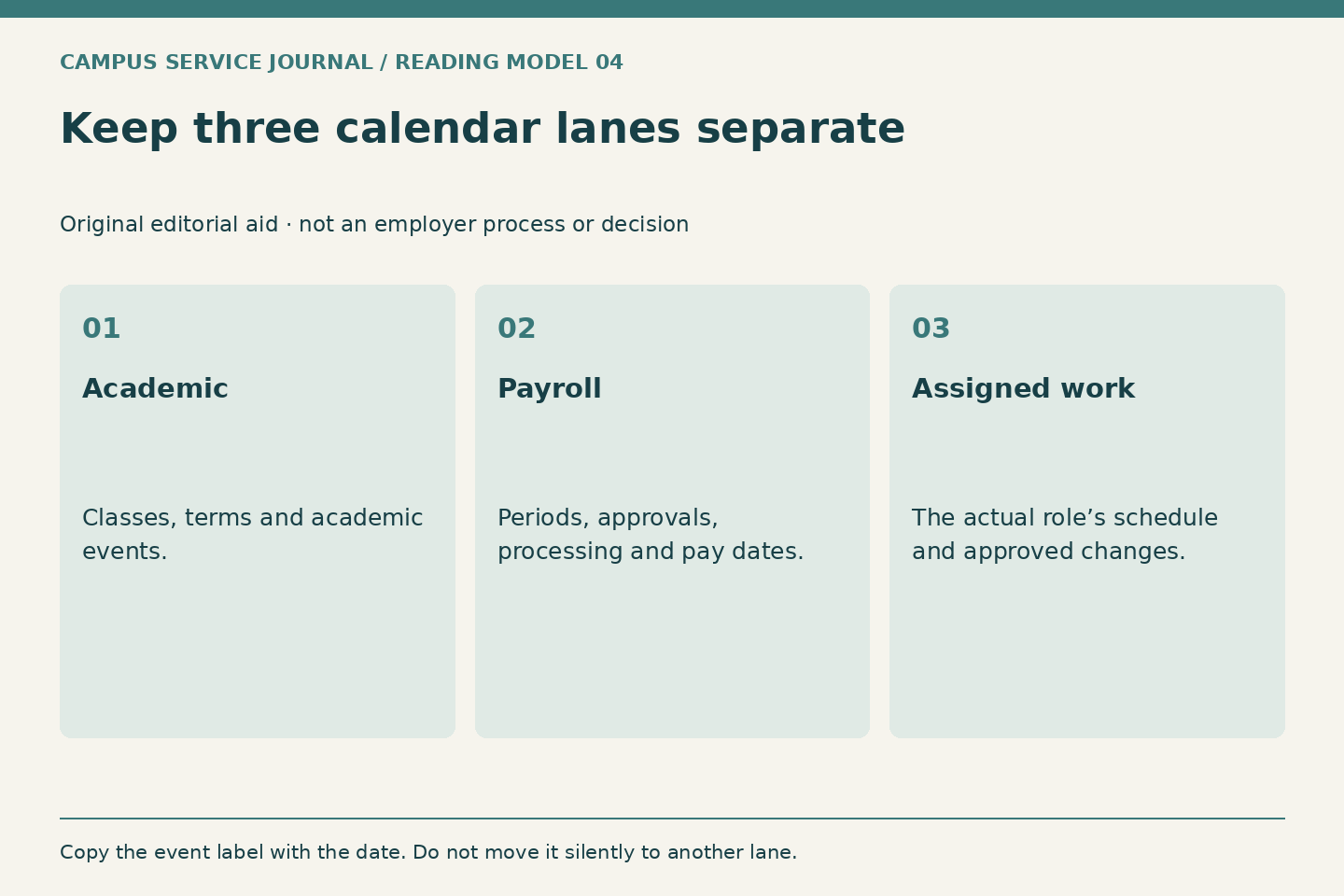
Our original worksheet uses one lane for academic events, one for payroll events and one for assigned work. Write the event name next to every date. An empty lane is allowed. If a source does not establish an individual's work assignment, leave that lane unresolved rather than copying a class closure into it. Visual alignment should never imply that the events have the same authority.
In a hypothetical exercise, a class schedule changes during a week that also contains a pay date. The academic change may matter to a student-facing service, but it does not by itself move the pay date or change a staff assignment. The reader should ask what official communication links those events, if any. Without that link, they remain separate facts.
Distinguish period, cutoff and payment
A pay period groups work or earnings for a defined purpose. A processing cutoff is an administrative event. A payment date is another event. The university's weekly and semimonthly descriptions should be read with their stated audiences and current calendar. Do not replace them with a generic rule from another university or assume that every employee uses the same cycle.
For a fictional record question, suppose a person knows when an event occurred and sees a later payment date. That does not prove the event entered that payroll. A narrow question asks which approved record and processing cycle apply. The calendar locates possible events in time; the relevant official record establishes what actually happened. Confusing those functions is a common source of false certainty.
Handle visible inconsistencies conservatively
Public calendars can contain revisions, typographical problems or a mixture of current and historical material. If a cell and explanatory text appear inconsistent, do not silently choose one and present it as settled. Record the exact page, month, event label and uncertainty, then consult the responsible official source. This is especially important when an extracted webpage table looks misaligned.
A good editorial response is to explain the reading issue and avoid publishing an unverified deadline. A private planning note can mark the date as awaiting confirmation. A search engine's recent crawl date does not settle the question, and a familiar pattern from earlier months is not enough to correct an official calendar on your own.
Keep role-specific schedules in their own lane
A dated Scheduling and Operations Coordinator posting provides an example of role-specific academic-year and summer scheduling language. Its terms belong to that job. They should not become a statement about all university staff or a promise that every campus office follows the same seasonal pattern. Actual assignments and approved arrangements require their own current evidence.
Imagine comparing a hypothetical event-support role and an academic-office role. Both may be affected by the academic year, but in different ways. Record what each notice says, what it qualifies and what is not established. Ask about the actual role rather than treating “university hours” as a complete answer. The title of the calendar is part of the evidence, not a detail to omit.
Make a date question easy to answer
A useful question identifies the event, population, period and source: which date applies to this named process for this audience? It does not need a full personal schedule or private payroll attachment unless the authorized office requests relevant information through its approved route. A concise question gives the recipient a better chance of seeing the real ambiguity.
The three-lane worksheet is complete when every copied date has a label and no date has silently migrated into another lane. It is a reading aid, not a scheduling system or entitlement determination. By preserving the difference between class activity, administrative processing and assigned work, a reader can plan more carefully and recognize which unanswered question actually needs confirmation.
Try the Two-Hat Reading Desk to prepare a bounded question.
Continue reading: MySlice at Syracuse: a shared doorway, distinct services, A repair, a quote and a project are different requests, Read a campus vacancy for duties, setting and proof.