In this guide
Begin with the capacity in which you are acting
A university community includes people who study, teach, work, supervise and support research. One person may occupy more than one of those roles. The useful question is not simply whether the person belongs to the university. It is which capacity is relevant to the particular record or decision. A student taking a class and working a paid shift can have academic and employment questions on the same day without those questions becoming one administrative case.
Syracuse's public ITS catalog describes MySlice as serving several audiences. That common doorway should not be mistaken for a common rulebook. The source that explains a student's academic task may not govern an employee's work record. This article introduces an independent audience-reading method. It does not test account permissions, classify a reader's employment, determine benefits or supply a private-system tutorial.
The two-role card
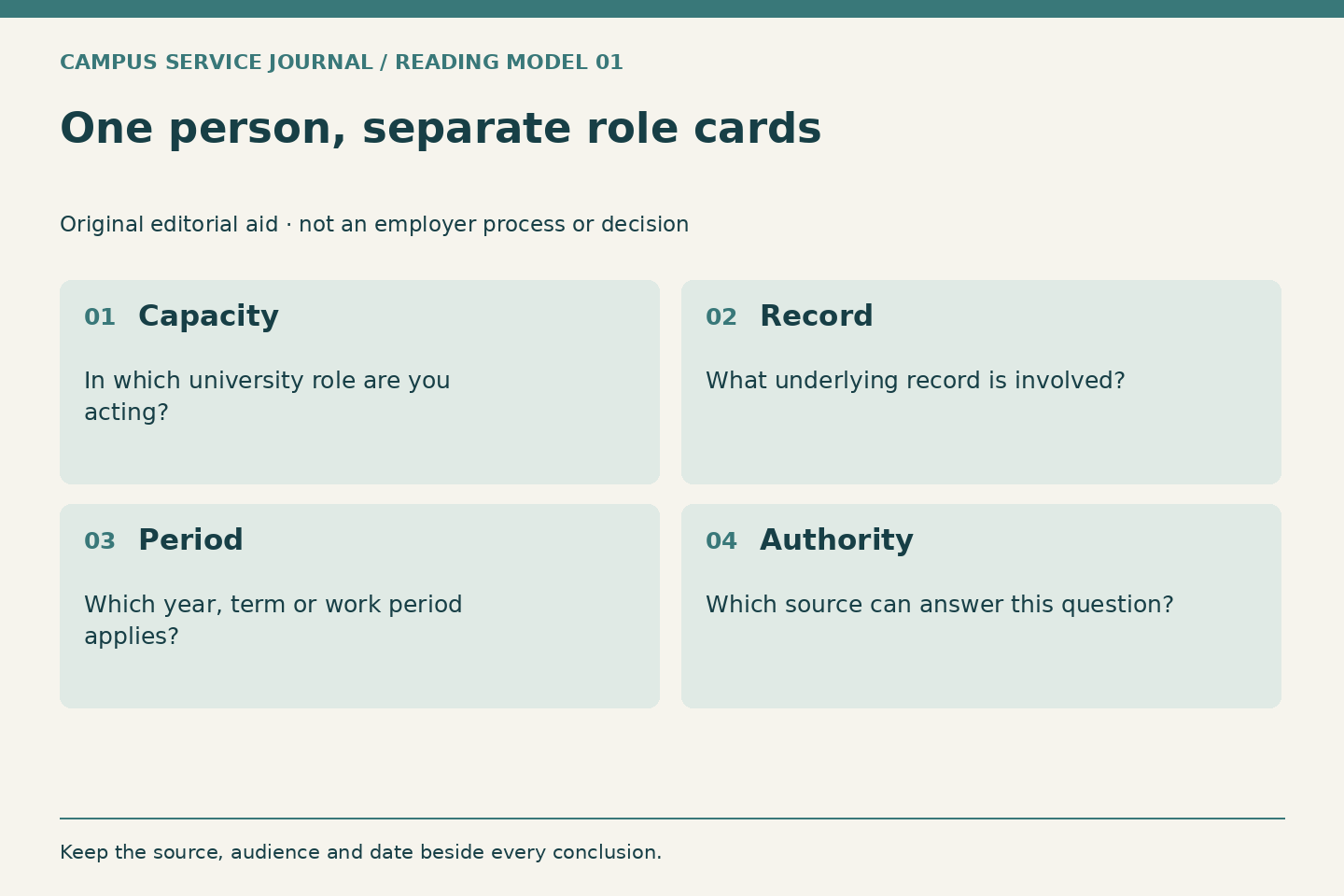
Draw two small cards rather than one large profile. Each card contains the role relevant to the task, the underlying record, the period and the responsible source. For a hypothetical student-employee exercise, one card might concern a class-registration record and the other a time record from authorized work. The shared person's identity is not the field doing the analytical work. The record and purpose are.
Then add the action being considered: understand, ask, submit or change. Understanding a public rule usually needs no private evidence. An individual transaction may require an approved process and appropriate information. Keeping those actions separate helps prevent a research session from becoming an unnecessary disclosure. You can ask which policy applies without attaching a transcript, pay statement or family document to an unrelated website.
Why benefits need a separate card
Employee benefits and student health insurance can both appear in a university search. The 2026 employee Benefits Guide index and the student health-insurance page identify different audiences and document periods. Their common institutional name does not make their eligibility rules, enrollment procedures or coverage equivalent. A reader should establish the applicable audience before comparing any terms.
A hypothetical reader may be eligible to investigate more than one kind of coverage, but this publication cannot resolve that situation. The editorial task is narrower: label the document, note the audience it names and prepare a question for the appropriate official office. Do not infer that one role automatically includes or excludes the other, and do not treat a student insurance date as an employee enrollment deadline.
A worked record-sorting exercise
Imagine a desk holding three pieces of information: an academic deadline, a notice about time recording and a benefit overview. Sort them by the decision each can support. The academic source addresses an academic event. The time-recording source addresses work information for its stated population. The benefit overview introduces a program whose governing documents and audience still matter. None should be used as a shortcut to answer the other two questions.
Now imagine that two documents use different dates for the same month. That difference is not necessarily an error. They may describe different events, such as class activity and payroll processing. Before requesting a correction, write the event label beside the date. A well-formed question can then explain the real mismatch rather than asking someone to reconcile two dates that were never meant to match.
Supervision adds responsibility, not unrestricted access
A supervisor or staff member may help other people navigate university processes. That support role does not make every record appropriate to request, view or forward. Follow the university's current training, authorization and information-handling requirements. Publicly knowing that a system contains a function is not evidence that a particular person may use it for a particular purpose.
For an original classroom-style exercise, replace personal records with three invented labels: academic request, work event and public policy. Practice identifying which source would answer each question without supplying names or identifiers. The exercise develops classification and restraint. It is not a permission map or a way to infer another person's account rights from their job title.
A useful result is a narrower question
The two-role card is complete when it can express the question in a sentence: “In this capacity, I need to understand this record for this period.” If the sentence still says only “MySlice problem,” it probably needs another pass. The actual next step may be official technical support, the responsible university office or simply a better reading of the public document.
Use current official sources for individual action. Keep private information within the appropriate approved channel. The value of this method is that it lets one person have several legitimate university roles without mixing their records or assumptions. A common portal can organize access; careful reasoning still has to establish which audience, source and decision belong together.
Try the Two-Hat Reading Desk to prepare a bounded question.
Continue reading: Read campus work through the service it makes possible, MySlice at Syracuse: a shared doorway, distinct services, Student employment: keep work evidence attached to the shift.