In this guide
Identify the work product
Administrative work can be difficult to describe because its results are often used by someone else. A corrected record, a clear instruction or a complete review packet may be less visible than the final decision it supports. Career preparation improves when it names that work product. The question is not merely whether a person is organized, but what their organization makes possible.
The September 2026 SU Global Operations Coordinator posting is a dated public example of records and coordination work. It does not define every administrative role. The university's position-evaluation material also emphasizes job descriptions as a source of responsibility context. Read the actual vacancy before deciding which experience is relevant.
Use an input–transformation–handoff account
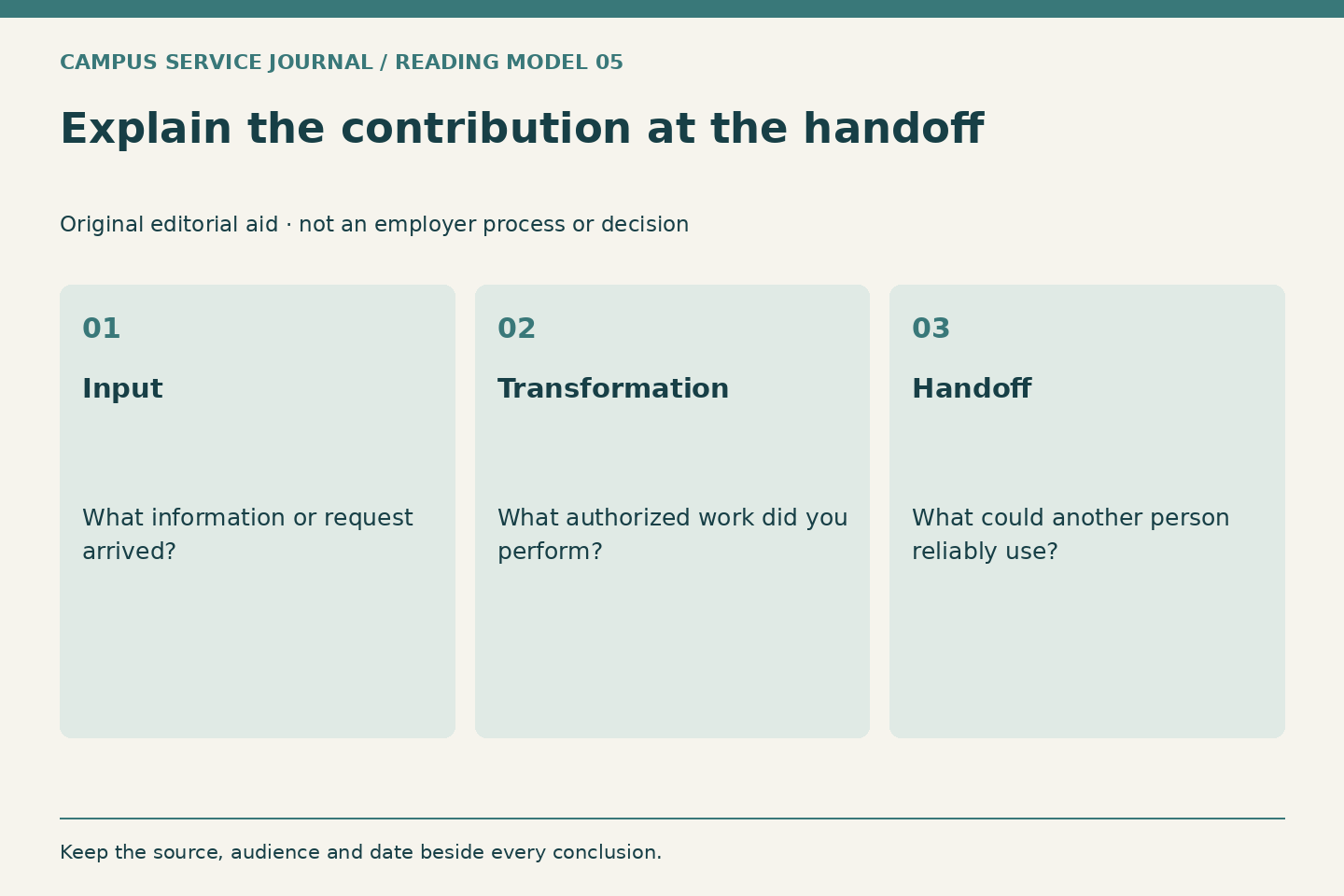
An original evidence model has three parts. The input is what arrived. The transformation is the authorized work you performed. The handoff is what another person could reliably use afterward. Include a limitation if the input remained incomplete. This structure makes a contribution visible without pretending that preparing a record is the same as approving its outcome.
For a hypothetical non-university example, imagine reorganizing a volunteer group's public event list. The input contains inconsistent dates. The work involves checking the authorized source and recording unresolved items. The handoff is a clearer list with open questions marked. That demonstrates a habit, not experience handling university student records.
Read accuracy as a process
Accuracy is not simply a personal trait. An example should show the check used to detect an issue and the source that resolved it. If the source was unclear, explain the escalation rather than inventing certainty. Avoid presenting confidential documents as portfolio proof; a safe description can establish the method without exposing the underlying information.
A useful follow-up exercise is to ask what would have happened if the unresolved item had been omitted. The answer can explain the service dependency and why the check mattered. Keep it proportionate and factual. Do not claim a dramatic institutional saving that was never measured.
Match the level of responsibility
Compare the example with the position's actual scope. Coordination, independent judgment, supervision and institutional approval are different responsibilities. A candidate should not claim all four because a task involved a spreadsheet or a meeting. If the role asks for a level you have not held, make that gap visible.
The result is a compact description of administrative work that another person can evaluate. It connects a real input to a useful output and a clear boundary. That is stronger career evidence than a long list of software names with no explanation of what the work accomplished.
Continue reading: A repair, a quote and a project are different requests, Put the year and audience beside the benefit, Good campus information work includes knowing what not to share.