In this guide
Read the scale before the amount
A compensation statement can describe a broad job category, a particular vacancy or an individual's employment terms. Those scales should not be collapsed. Syracuse's public staff-pay page explains that pay bands encompass classifications while a position's range may be narrower. That is a useful starting distinction. It does not tell this publication where a reader belongs within a range or what an employer will offer.
The first note beside any amount should identify its unit, audience and period. Is it hourly or another pay basis? Which role or category does it describe? Which location is named? When was the source published and when did you check it? A number without those labels can look precise while answering the wrong question.
A dated posting example
The official indexed Operations Coordinator posting for SU Global, job 042909, dated September 15, 2026, listed $19.45–$21.65 per hour for Syracuse, New York when reviewed October 1. The same notice identified a non-exempt staff role. These are details of that dated example. They are not a university-wide rate, a personal offer, or confirmation that the vacancy remains open when someone later reads this article.
A reader comparing another role should create a separate label for that posting rather than carrying this figure forward. Even a similar title may sit in another department, have different responsibilities or use a different pay basis. Search-result proximity and title similarity are not evidence that the terms are interchangeable. The current official notice is the appropriate starting point for the actual application.
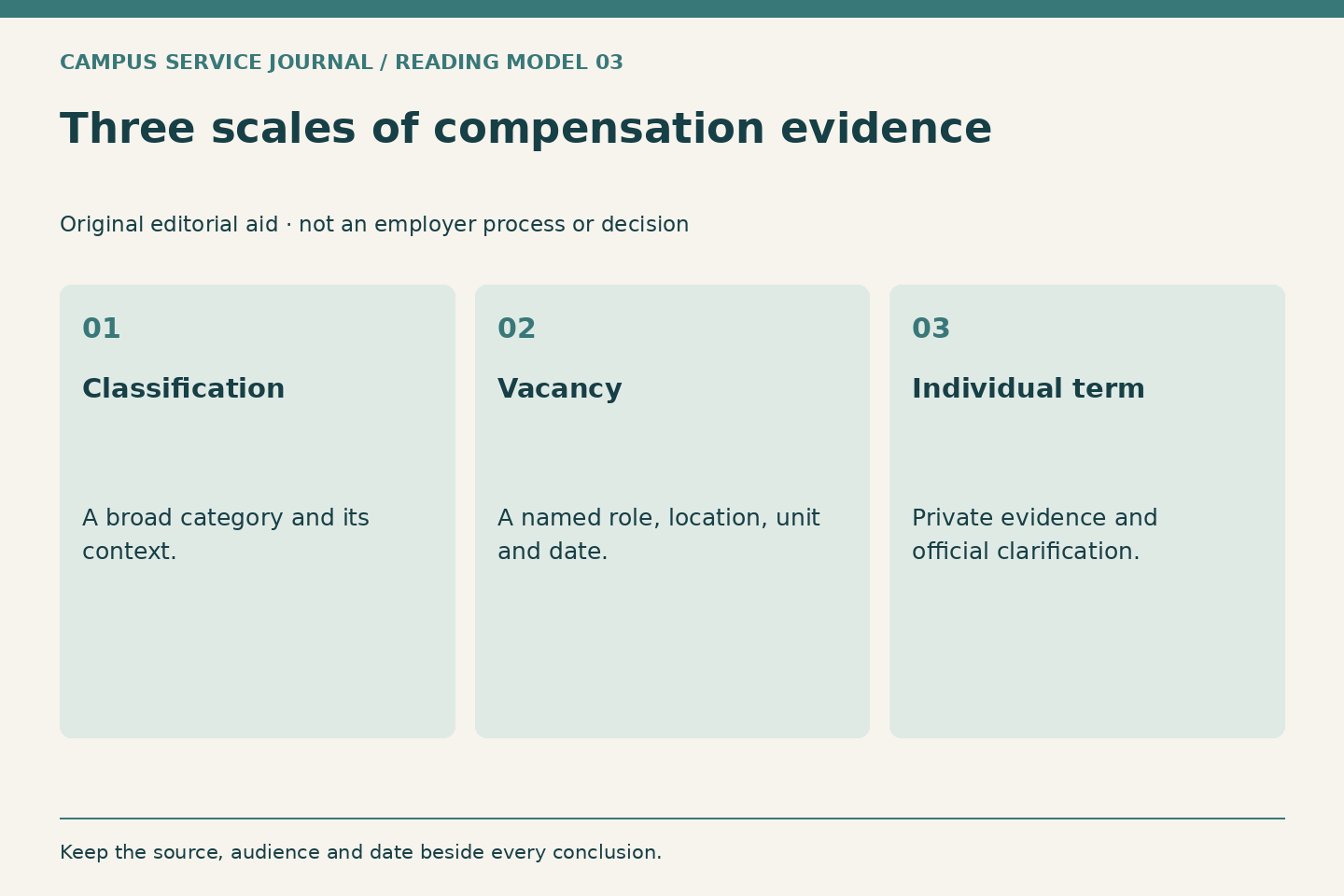
Use a three-scale reading sheet
The broadest scale is classification context. The middle scale is the specific job notice. The narrowest scale is an individual written term or official clarification. Record what each source can establish, then leave a line for what it cannot. This is not a hierarchy saying every narrow document overrides every broad one; applicable policies and agreements can govern the interpretation. It is a way to stop treating unlike statements as equivalent.
In a hypothetical comparison, a reader sees a broad band with a high endpoint and a vacancy with a smaller range. The useful question is why the two describe different scopes, not why the vacancy fails to promise the band's maximum. The source may be functioning exactly as intended. An official compensation explanation is more useful than assuming a calculation error from the endpoints alone.
Do not manufacture an annual figure
An hourly amount cannot be responsibly compared with an annual amount unless the relevant hours and terms are known. A quick multiplication may silently assume a full year, a fixed weekly schedule and no variation. Those are inputs, not facts supplied by the mere presence of an hourly rate. Keep the original units visible until the comparison has an adequate basis.
For a fictional worksheet, imagine one notice states an hourly range while another states an annual range and a different schedule. The worksheet can record both accurately and mark the hours basis as unresolved. That is a useful result. An empty field should remain an unknown, rather than becoming zero or a convenient assumption that makes a preferred role appear better.
Separate pay from the rest of the offer
A compensation figure does not describe every part of an employment decision. Appointment type, location, schedule and benefit-document audience belong in their own rows. A public benefit category should not be assigned an invented monetary value and added to a posted rate. Individual participation, costs and timing may require governing documents and official clarification.
Likewise, a paycheck is not simply the posted rate repeated in another format. The university's public paycheck guide distinguishes kinds of amounts and periods. This article does not interpret tax withholding, determine deductions or calculate net pay. A reader with a personal statement question should use the current secure payroll process, not send the statement to an independent publisher.
End with the missing fact
A good pay comparison ends with a precise missing fact, if one remains. That might be the relevant work basis, the applicable role category or how a stated range should be understood. It should not end with a confident personal prediction assembled from a band, a job snippet and a general benefit page. Each source contributes only what its scope supports.
This is document literacy, not financial, tax, legal or salary-negotiation advice. Keep geography, audience, unit and date beside every figure, and use the current official employer process for individual terms. The practical benefit is a comparison another reader could reconstruct and a question the responsible office can answer without first undoing several hidden assumptions.
Try the Two-Hat Reading Desk to prepare a bounded question.
Continue reading: Three calendars can describe one week, Administrative work leaves a trail of usable decisions, When a deduction changes, begin with a dated comparison.